
EQ Saturday Sapience #193
Equity Intelligence 17th October 2026
"Managers that always promise to ‘make the numbers’ will at some point be tempted to make up the numbers.” — Warren Buffett
Beyond the Numbers. In this episode of On The Money, a podcast by Interactive Investor, Carlos Hardenberg, portfolio manager at Mobius Investment Trust, discusses his contrarian approach to emerging markets, why he has rebuilt exposure to Indian mid-cap companies, and why he remains cautious about China. He challenges the idea that investors should simply follow market benchmarks, arguing that opportunities can lie beyond crowded, familiar stocks. In India, he sees potential in businesses serving the country's growing affluent population, from wealth management to refurbished electronics. He also highlights the less obvious beneficiaries of the AI boom: companies supplying the specialised cables, components and infrastructure that data centres depend on. But the most striking insight comes from his reflections on the late Mark Mobius, with whom he worked for 25 years. Financial analysis can reveal a great deal about a business, but understanding its leadership, culture and governance requires a different kind of judgement. Hardenberg argues that many business successes and failures ultimately come down to the people running them. Watch more
The Dependency Nobody Wrote Down. In March 2025, a fire at a single electricity substation shut London's Heathrow Airport for a day, cancelling around 1,300 flights. The transformer fault had been known since 2018, yet the airport's dependence on that supply point had gone unrecognised. A similar vulnerability surfaced when a cyberattack halted Jaguar Land Rover's production for five weeks, with losses estimated at £1.9 billion and disruption spreading to more than 5,000 supply-chain businesses. Both incidents reveal a blind spot: businesses map financial relationships, but often overlook their dependencies. The challenge is not just identifying these connections, but understanding how a failure in one place can cascade through the wider economy. Read more
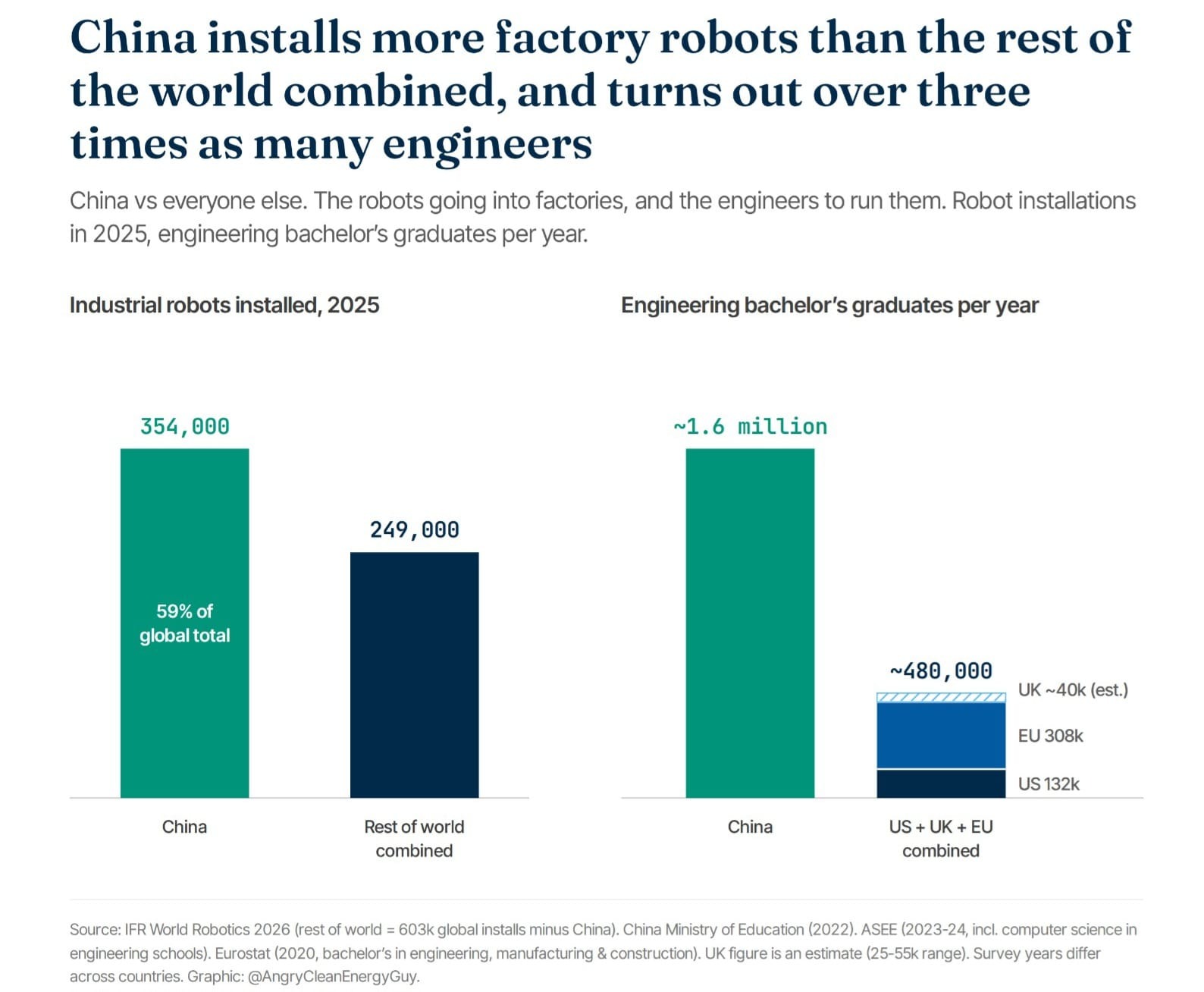
China's Battery Empire: The Cost of Catching Up. In 2005, China had just two EV battery makers. Today, it accounts for more than 75% of global battery sales. This dominance was built over two decades through subsidies, a protected domestic market and fierce competition between local manufacturers. The result is an industry that produces cheaper batteries and has built expertise across the supply chain. Chinese companies are now taking this ecosystem overseas, while India is still trying to develop its own capabilities. In FY26, nearly 84% of India's lithium-ion battery imports came from China, costing $4.7 billion. India faces a difficult trade-off: restrict Chinese investment on national-security grounds, or allow greater access to the technology and expertise needed to catch up. Read more
The AI boom is producing dazzling valuations but increasingly unreliable financial yardsticks — from inflated revenue run rates to creative earnings metrics. When even the numbers become difficult to trust, distinguishing genuine value creation from financial engineering becomes an investor’s biggest challenge. Read more
Disclaimer:
The content of this newsletter include links to third-party websites as a convenience, and the inclusion of such links does not imply any endorsement, approval, investigation, verification or monitoring by Equity Intelligence Pvt Ltd. If you choose to visit the linked sites, you do so at your own risk, and you will be subject to such sites' terms of use and privacy policies. Nothing in this newsletter should be construed as investment advice. The information contained herein is only as current as of the date indicated and may be superseded by subsequent market events or for other reasons. There is no guarantee that the information supplied is accurate, complete, or timely.