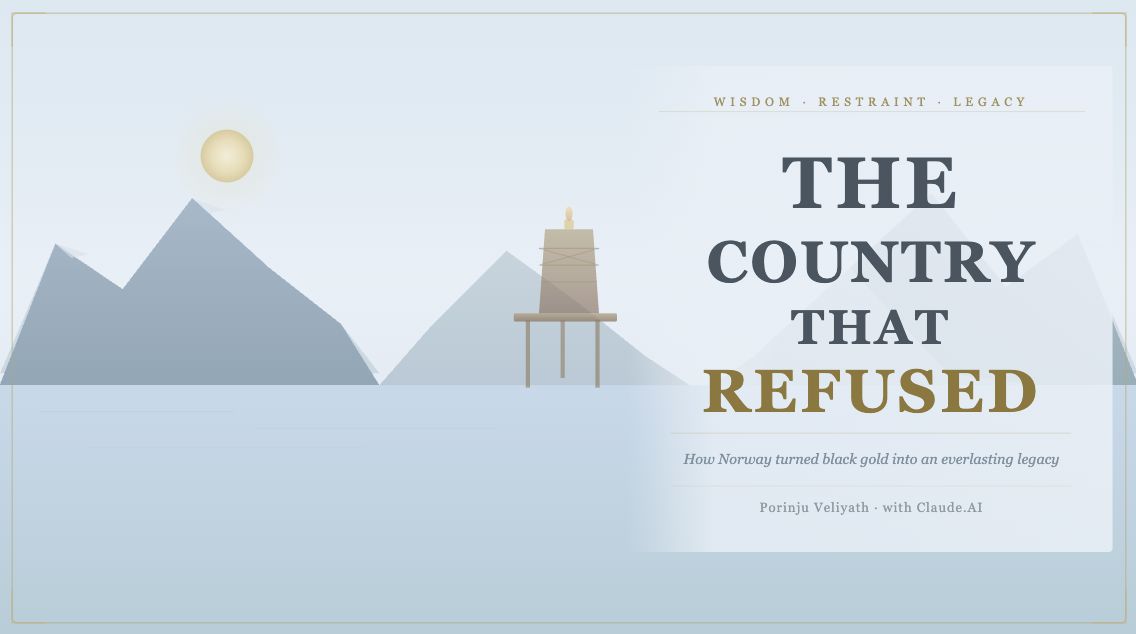
The Country that Refused to Spend its Fortune
Porinju Veliyath 30th March 2026
Part One
A Night That Changed Everything
Somewhere beneath the grey, indifferent waters of the North Sea, on the night the rest of the world was unwrapping Christmas gifts and drinking warm wine, a drill bit hit rock that would rewrite history.
It was December 24, 1969. The crew of an American oil company would have been forgiven for thinking the date was coincidental — a gift, almost theatrical in its timing. The Ekofisk field, one of the most significant offshore oil deposits ever found in European waters, had just announced itself to the world.
Up above, on land, in the modest towns of a modest country, fishermen were sleeping. Farmers were sleeping. Politicians were sleeping. None of them knew yet that their nation had just become, in geological terms, astonishingly rich.
Norway in 1969 was not a poor country. But it was not a powerful one either. It had no empire. No nuclear arsenal. No seat at the table where global decisions were made. It was a long, thin sliver of coastline at the top of Europe — beautiful, quiet, and largely irrelevant to the calculations of the world's great powers.
That was about to change. The question, the only question that ever matters when fortune arrives uninvited, was not: what do we have? It was: what do we do with it?
Most nations, faced with sudden wealth, answer that question badly. Norway answered it in a way no one had quite managed before.
Part Two
The Ghost of Every Oil Nation
Before we talk about what Norway did, we need to talk about what countries usually do. Because the pattern is old, well-documented, and almost uniformly tragic.
Nigeria found oil in the 1950s. By the turn of the millennium, it had earned hundreds of billions of dollars from petroleum. And yet the majority of its citizens lived in poverty. Infrastructure crumbled. Corruption became so embedded in the system that it stopped being a scandal and became simply the way things worked.
Venezuela struck oil and rode a wave of short-term prosperity — hospitals built, prices subsidised, popularity purchased. Then oil prices fell. The money ran out. And the institutions that might have cushioned the fall had been hollowed out by decades of easy spending. What followed was one of the worst humanitarian crises in the Western Hemisphere in living memory.
Libya. Angola. Equatorial Guinea. The list goes on. Economists even gave the phenomenon a name, clinical in its detachment: the Resource Curse. The idea that natural wealth, counterintuitively, often leaves a country worse off than if the resources had never been found at all.
The mechanism is not mysterious. Easy money distorts economies. It inflates currencies, making everything else — manufacturing, agriculture, exports — uncompetitive. It creates political incentives to spend now and ignore tomorrow. It attracts corruption like light attracts moths. And when the resource eventually runs out, the country is left with less than it started with: weakened institutions, dependent citizens, and a generation of leaders who never learned to do anything except divide the pie.
Norway had read the history. And Norway decided, with unusual firmness, that it was not going to repeat it.
Part Three
The Art of Saying No
There is a peculiar kind of discipline required to hold money in your hands and not spend it. Most individuals cannot do it. Most governments cannot do it. It runs against every instinct — personal, political, and economic.
And yet that is essentially what Norway decided to do.
In 1990, the Norwegian Parliament passed legislation creating the Government Petroleum Fund. The architecture of the idea was almost aggressively simple. Every krone that flowed from oil revenues would be channelled into the fund. The fund would invest exclusively abroad — not in Norway itself, so as not to artificially inflate the domestic economy. And each year, the government would be permitted to spend only a modest fraction of the fund's expected long-term returns. Not the principal. Not a windfall payment to voters. Just the returns, and only a portion of those.
The first actual deposit into the fund did not arrive until 1996. A modest sum, more symbolic than transformative. What followed was something rarer than money: consistency.
Elections came and went. Finance ministers arrived and departed. Economic crises battered global markets. Each time, the temptation to dip into the fund presented itself. Each time, Norway refused. Politicians who campaigned on spending the oil money discovered that Norwegian voters were, on this one issue, strangely united. The fund was not theirs to spend. It belonged to people not yet born.
That is not a small thing. That is, in the history of democratic governments managing public wealth, almost unheard of.
$2.23 Trillion
FUND VALUE AT END OF 2025
The world's largest sovereign wealth fund
$400,000
PER NORWEGIAN CITIZEN
Shared equally across 5.6 million people
7,200
COMPANIES INVESTED IN
Across 60 countries and every major market
Part Four
The Machine That Runs Itself
Here is what the fund actually does, stripped of mystique.
It buys small stakes in companies — thousands of them, spread across sixty countries. Technology firms in California. Banks in Frankfurt. Real estate in Tokyo and Paris and Manhattan. It does not try to pick winners. It does not chase fashionable sectors or bet on trends. It simply buys a broadly representative share of the entire global economy and waits for the world to grow.
Which, over time, it does.
Since its first investments in 1998, the fund has generated an average annual return of around 6.6%. In 2025 alone, it posted one of the largest single-year gains in its history — a 15.1% return, driven by surging technology and financial stocks. Its portfolio of renewable energy infrastructure returned 18.1% that year. Its equity holdings alone rose nearly 20%.
The result of all that compounding patience is that Norway now owns approximately 1.5% of every publicly listed company on the planet. Every time Apple sells an iPhone, every time a European bank posts a profit, every time a mining company in Australia ships ore — a tiny fraction of that value belongs to Norway.
They didn't just save the oil money. They used it to buy a permanent share of the world's future productivity.
And here is the number that most surprises people when they encounter it for the first time: more than half of the fund's current value did not come from oil revenues at all. It came from investment returns. The machine, once set in motion, began generating more wealth than the oil wells themselves.
Part Five
A Fund With a Conscience
Norway could have simply chased maximum returns and left the ethics to someone else. That would have been the easier path.
Instead, since 2004, the fund has operated under a formal set of ethical guidelines, overseen by an independent Council on Ethics. The principle is straightforward even if the application is not: the fund will not profit from activities it considers incompatible with civilised standards.
This means no tobacco producers. No manufacturers of cluster bombs or nuclear weapon components. No companies engaged in severe environmental destruction. No firms found complicit in systematic human rights abuses or gross corruption. Over 180 companies have been excluded over the years. The decisions are made public, with written explanations — a level of transparency unusual even by Scandinavian standards.
More recently, the fund has begun using artificial intelligence — specifically, large language models — to screen every new company that enters its portfolio, flagging potential links to forced labour, corruption, or fraud within twenty-four hours of investment. Often, the AI identifies issues before they have surfaced in mainstream media or data provider alerts.
The system is not without controversy. Decisions about which companies to exclude have occasionally drawn diplomatic criticism, most recently from the United States, which objected to divestments linked to the conflict in Gaza. Norway's finance minister responded simply: these were not political decisions. They were ethical ones.
The distinction matters. A fund of this size that operates with explicit ethical commitments is not just a financial instrument. It is, whether it chooses to be or not, a statement about what a wealthy nation believes it owes the world.
The Timeline
Seven Decades in Seven Lines
1969 Ekofisk oil field discovered beneath the North Sea on Christmas Eve
1990 Norwegian Parliament establishes the Government Petroleum Fund
1996 First capital deposit made into the fund
2004 Ethical guidelines established; independent Council on Ethics formed
2021 Fund begins investing in renewable energy infrastructure
2025 Fund posts 15.1% annual return; AI deployed to screen investments ethically
2026 Total fund value exceeds $2.2 trillion — roughly five times Norway's GDP
Epilogue
What They Built for Strangers
The geologists say the oil will run out in thirty to fifty years, perhaps a little more, perhaps less. It is a finite thing, always was. The whole point of the fund was to ensure that when the wells finally go dry, Norway does not go dry with them.
By any reasonable projection, that goal has already been achieved. The fund's size today means that its investment returns alone are sufficient to fund significant portions of Norwegian public services indefinitely. Norway has already, in the language of finance, decoupled itself from oil. Its financial wealth is now estimated to be roughly five times greater than the remaining value of its petroleum resources in the ground.
In other words: even if the oil stopped tomorrow, Norway would be fine.
That is an extraordinary thing for a government to be able to say. And it was made possible not by geological luck — plenty of countries have found oil — but by an almost perverse commitment to patience. To the idea that the purpose of money is not to be spent today, but to serve people who do not yet exist.
The men and women who built the fund are mostly gone now. They never saw the trillion-dollar numbers. They built it anyway — for grandchildren who hadn't been born yet, in a world they couldn't fully see.
We tend to think of wisdom as something individuals possess — a quality of mind, a kind of acquired calm. But occasionally, rarely, a government manages to encode wisdom into its institutions. To build systems that survive the vanity of politicians, the impatience of voters, and the constant, human pressure of now.
Norway did that.
They found oil. They built a wall around the money. They invested it in the world. And then — this is the part that most defies explanation — they kept their hands off it.
In 1969, Norway found oil.
In 1990, it found something rarer.
The discipline to leave it alone.